-
What Does a Material Name Actually Tell You
-
Why the Forming Method Belongs in the Spec
-
What the ADA Seal Statement Actually Covers
-
Split the Request Into Two Documents
-
Walk the Sourcing Steps From Spec to Sample
-
How Do You Confirm Each Step Was Done Right
-
What Decides Approval When the Sample Arrives
"If I write EVA on the material request, what have I actually proved?" A material family tells you what the guard would be formed from, and it stops there. It says nothing about whether the build you eventually receive is supported by anything more than that word on a line. Those are two separate questions, and a single blended RFQ answers only the easy one.
The structure that works is two documents. One is a fabrication spec: material family, forming route, how the impression or model crosses the handoff, and who holds the fabrication record. The other is a one-question evidence file: what finished-product, in-mouth evidence exists for the build we would be quoted. Send them as separate files with separate owners on the supplier side, so that a vague reply has nowhere obvious to hide.
What Does a Material Name Actually Tell You
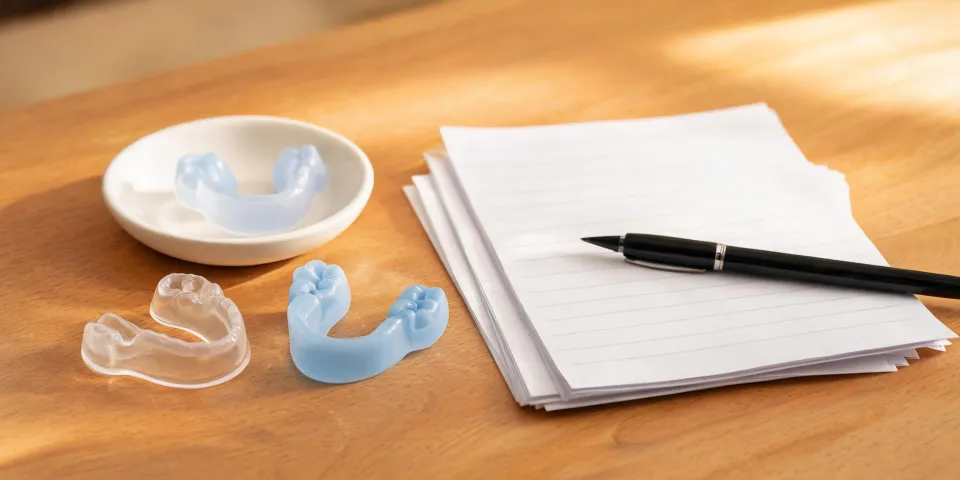
The ADA's athletic mouthguard guidance names EVA, polyolefin and a polystyrene-polyolefin copolymer as materials used to fabricate custom mouthguards. Read that sentence for what it is: a statement about inputs. It describes what a custom guard is formed from, which means it cannot answer whether the piece in your hand is supported for in-mouth use. The reason is structural rather than nitpicky — a material family is a category, and a category does not carry product-level evidence with it.
It is still worth having. A named family turns a vague sample into a checkable item: you can ask which of the three you are being quoted, ask for the material documentation that travels with the lot, and compare two quotes on the same basis instead of on two different adjectives. What the name does not do is move the safety question an inch. Trouble starts when a supplier's one-line reassurance gets filed as one fact instead of two unrelated claims stacked on top of each other.
Why the Forming Method Belongs in the Spec
Custom mouthguards are fabricated in a dental office or laboratory from individual patient impressions using thermoforming techniques, typically vacuum-forming or pressure-forming. That sentence holds the second half of your spec, and it is the half most requests skip. The geometry of a finished guard comes from the impression and the forming step, not from the resin, because the material only takes the shape the process gives it. Two plants can name the same polymer family and still hand you different builds.
Which means the forming route belongs on the spec sheet beside the material line, not buried in a price schedule or inferred from a photo of a finished guard. Ask whether the plant vacuum-forms or pressure-forms, how the impression or digital model arrives and where it is stored, who signs the fabrication record, and what exactly the sample will be made against. Those are questions about the vendor's process, not instructions for running it. Comes down to this: a spec you cannot later inspect is a wish with a part number.
What the ADA Seal Statement Actually Covers
The Seal language is narrower than the way it gets repeated in sales threads. A product earns the ADA Seal for athletic mouthguards by providing scientific evidence, evaluated against objective requirements, demonstrating the safety and efficacy of OTC mouth-formed (boil-and-bite) mouthguards. Read the closing words of that sentence twice. The products named there are over-the-counter and mouth-formed.
The reason that scoping matters to your order is that a laboratory-fabricated custom guard is a different product type, which means a supplier invoking "ADA" for a custom build is citing something outside the described scope until product-specific evidence is placed in front of you. That is a statement about which document answers which question, not an accusation that custom guards are unsupported. Nothing on that page settles whether any particular custom product is or is not Seal-eligible. That question goes to the supplier, and where clinical judgment is involved, to a dental professional rather than to a sourcing spreadsheet.
Split the Request Into Two Documents
File one, the fabrication spec, carries the material family being quoted, the forming route, how the impression or model crosses the handoff, the definition of the sample build, and the name of whoever holds the fabrication record. Every line is documentary and inspectable at the sample stage.
File two carries a single question: what finished-product, in-mouth evidence exists for the build we would receive, and what is the scope of that evidence? Nothing else goes in that file. Suppose a supplier comes back with "ADA approved EVA." That reply closes file one and fails file two, because it restates a material and a category while the question asked about a product. Keeping the files apart is what makes the failure visible; blended into one RFQ, the same sentence reads like a full response and the open item disappears.
Walk the Sourcing Steps From Spec to Sample
Sequence matters more than the wording of any single line. First, list material families and forming route as open questions rather than preferences — at this stage you are collecting answers, not negotiating. Second, send the evidence file on its own thread so its answer cannot arrive bundled with a price. Third, log each reply against the question it actually answered: documents against the evidence file, material names against the spec file.
Fourth, request the sample against the written spec rather than against a description in an email, because the answer at that point too often comes back as a material name and a shrug, and a sample built on a shrug is a sample you will build twice. Fifth, when the sample lands, walk the spec line by line against what the plant documented, and mark each line as matched or open.
Quote, MOQ, lead time, capacity, customisation rights and sample performance stay open until written answers arrive. Do not fill them from a reference brand's published page; a competitor's numbers were never a commitment from the plant quoting you, and the mismatch surfaces after tooling, not before. This is where a quote sheet starts doing the talking for a spec nobody wrote, and how a project ends up approving something nobody actually described.
How Do You Confirm Each Step Was Done Right
An item counts as answered only when the reply names the product actually being quoted and states the scope the answer applies to. A material name, a category reference, or a mark used as a stand-in for either of them leaves the item open, no matter how confident the phrasing sounds.
Suppose the evidence file returns a careful paragraph about boil-and-bite products. That is a real statement about a real product type, and it does not describe the lab-fabricated build in your quote. Suppose instead it returns a document naming the build, the material, the forming route and the evidence scope. That closes the item, because it answers the question that was asked, which is the only test the file applies.
Confirmation on the spec file is just as documentary: each line needs a matching written record from the plant, whether that is a material declaration, a process note or a signed sample sheet. Where a line has no match, carry it forward on the open list. Open items that stay on the record get resolved eventually; open items absorbed into a quote never do.
What Decides Approval When the Sample Arrives
Approval rests on two files agreeing at the same time: the fabrication record matching the spec line for line, and the evidence file carrying an answer scoped to the build you would receive. Both are paper checks. Neither asks a buyer to interpret a mechanical claim or to grade a material by hand.
Where no product-specific protective-performance or clinical evidence exists for this build, the honest status is unverified on that axis, and that is a defensible position to hold through a first order. What is not defensible is converting a material name, a reference product's credential or an internal assumption into a performance claim for a build nobody documented — you would take on the exposure without the file that supports it. Leave the axis open, date the follow-up question, and let the purchasing decision rest on what is on paper.
Today's action: take the material request sitting in your drafts, split it into a fabrication spec file and a one-question evidence file, and send the evidence file alone to whichever supplier answered you with a material name. Whatever comes back, or does not come back, goes on the open list as a recorded item with a date against it.
